Voting is the best way to have your say about what happens locally. It’s how you choose who will represent you on the Wattle Range Council and helps shape the future of your community.
The Wattle Range Council is made up of four local wards
Council Elections are held every four years via postal vote. The next General Election is in November 2026.
Residents in each ward are represented by their Elected Members who are appointed during Council Elections.
Wattle Range Council is formed by the Mayor and 11 Elected Members, also known as Councillors from across the Wattle Range Council area.
Each Councillor represents one of the four Council Wards, they are elected by the community of the respective wards. The Mayor is elected by the whole community. See Elections
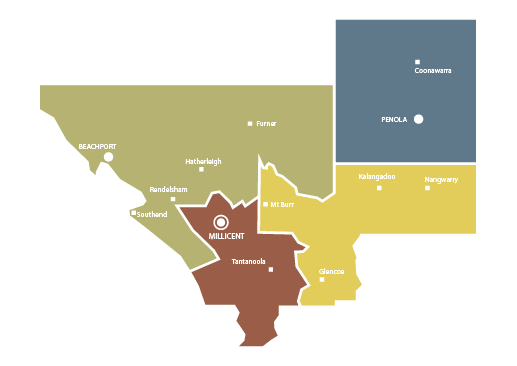
Kintore Ward
Includes the towns of Beachport, Southend, Rendelsham, Hatherleigh and Furner (2 Councillors)
Riddoch Ward
Includes the towns of Penola and Coonawarra (2 Councillors)
Corcoran Ward
Includes the towns of Millicent and Tantanoola (5 Councillors)
Sorby Adams Ward
Includes the towns of Mount Burr, Glencoe, Kalangadoo and Nangwarry (2 Councillors)
Contact your Mayor and local councillors about issues important to you
You can contact the Mayor or Elected Members about any matter relating to council, or about anything that is impacting or influencing your experience in the Wattle Range Council area. You can contact any of the Elected Members–you do not have to contact your local member or the member for the ward to which the matter relates.
Meet your Elected Members
Corcoran Ward
Kintore Ward
Riddoch Ward
Sorby Adams Ward
The role of our Elected Members
Elected Members serve a four-year term. Council elections are held every four years, with the next one in 2026, when all positions will become vacant.
A Councillors’ role is to represent the views of residents and ratepayers, provide community leadership and guidance, and facilitate communication between the community and the Council.
Their role also includes representing council on other bodies and meetings and taking part in discussions and decision making at Council and committee meetings.
Decisions made at a formal Council meeting provide the direction and authority for Council's ongoing operations. These decisions give direction to the CEO and are carried out by Council staff.
Meetings also allow the Mayor and Councillors to decide the Council's policy direction and make decisions on statutory matters.
Council is a corporate body and can only make decisions by resolution. A motion must be raised during an official meeting and passed by a majority vote.
Behavioural Standards for Council Members
Behavioural Standards for Council Members are established by the Minister for Local Government pursuant to section 75E of the Local Government Act 1999 (The Act).
Behavioural Standards for Elected Members (PDF, 156 KB)
These Behavioural Standards set out the minimum standards for behaviour that are expected of all council members in the performance of their official functions and duties.
In addition to the standards, Council has their own Behavioural Support Policy which sets out behaviours agreed to be observed by Council Members.
Wattle Range Council Behavioural Support Policy (PDF, 291 KB)
Council's Behavioural Management Policy sets out Council's approach to the management of complaints about the behaviour of Council Members.
Wattle Range Council Behavioural Management Policy (PDF, 208 KB)