
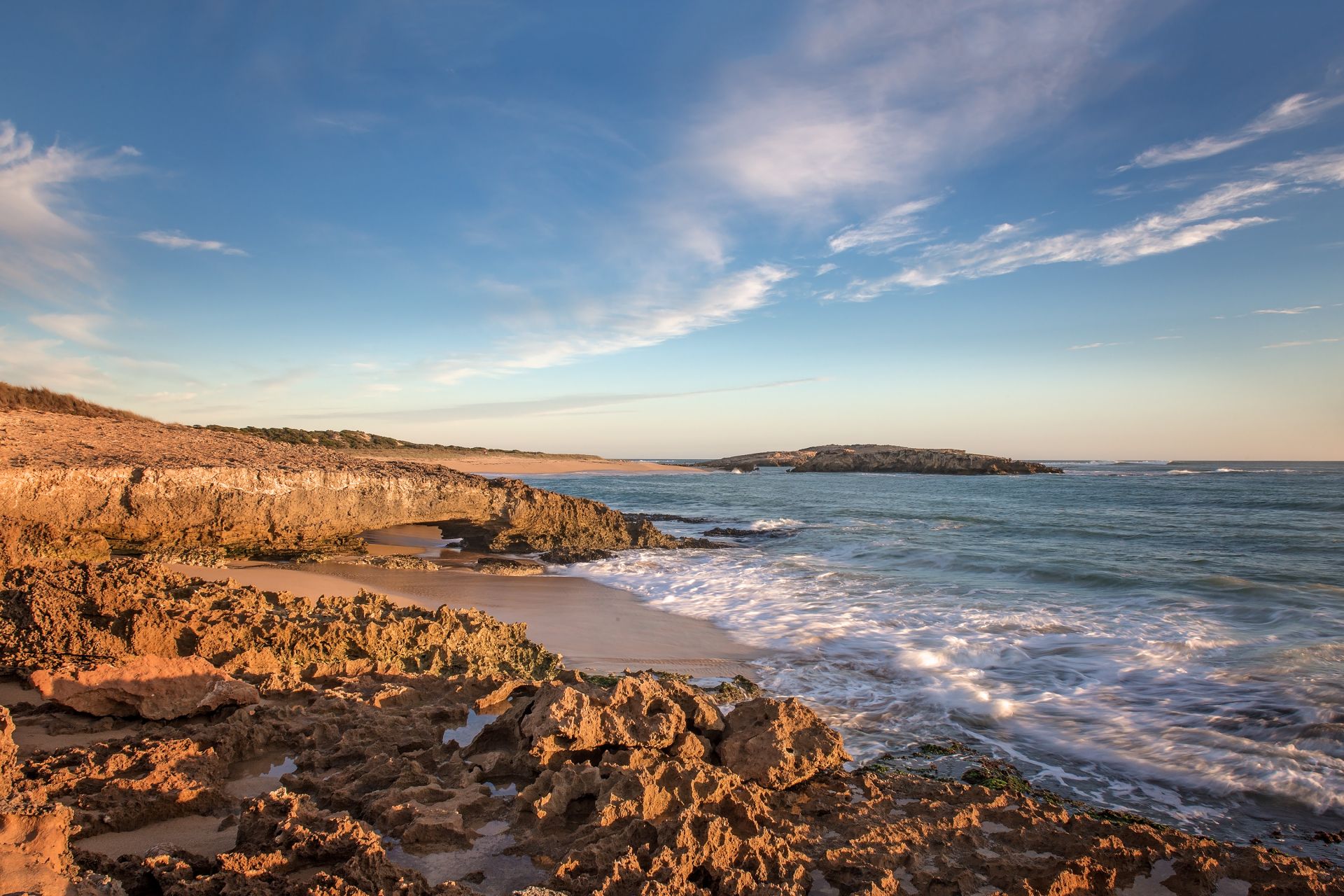
Wattle Range Council helps care for and plan for the future of our coastline to support the community, protect important infrastructure and preserve the environmental, social and economic values that make Southend and Beachport unique.
Our coastline is constantly changing. Coastal processes such as erosion, flooding, storm events and sea level rise can affect coastal communities over time. Council works to understand these challenges through research, monitoring and community consultation, helping ensure informed decisions are made for the future.
This includes considering coastal risks in future planning and development decisions, working with government agencies, technical experts and the community to explore adaptation options, and advocating for funding and support to deliver coastal management projects that help protect and strengthen our coastal communities.
2026 | Beachport Coastal Adaptation Strategy
Following several years of research, modelling and consultation with key stakeholders and the community, Council developed the Beachport Coastal Adaptation Strategy in 2026.
The Strategy sets out a long-term plan to manage coastal hazards such as erosion and inundation (both permanent and temporary) through to 2100. It also explains how and when different adaptation actions may be triggered over time.
The Beachport Coastal Adaptation Strategy outlines a plan for future coastal hazards and risks affecting the township of Beachport. The Strategy and the accompanying technical report provides a long‑term framework to guide Council decision making and future planning for the Beachport coastline, supporting a proactive and informed approach to coastal adaptation.
See the Beachport Coastal Adaptation Strategy 2026 (PDF 5.4 MB)
Visit the Beachport Coastal Adaptation Strategy consultation page
2022 | Rivoli Bay Modelling
The impacts of coastal processes are visible in and around both Southend and Beachport. Historically these impacts have been managed with coastal infrastructure such as groyne fields and seawalls, and a range of management activities such as sand carting.
Council has completed several coastal studies to better understand coastal management challenges in Beachport and Southend, including ongoing sand build-up at the Beachport Boat Ramp. These studies included community input and identified a range of possible management options.
To build on this work and better assess these options, Council partnered with the Coast Protection Board to undertake detailed data collection and modelling for Rivoli Bay.
2018 | Southend Adaptation Strategy
The coastline of Southend and Rivoli Bay are important community, natural and economic assets. While storms have always had an impact on local beaches, the coast is increasingly being affected by sand erosion and has the potential for inundation.
Without action, coastal assets, public land and infrastructure near the coast at Southend will experience increased erosion and inundation risk. Recognising the value of the coastline to the community, Council worked with the Southend community to develop the Southend Adaptation Strategy, supported by the Coast Protection Board and the Local Government Association of South Australia.
Council considered community feedback before adopting the Strategy on 10 April 2018. The Strategy complements the Southend Community Plan.
See the Southend Adaptation Strategy (PDF 7.3 MB)
The main hazards caused by the coastal processes relevant to Southend include:
- short-term coastal erosion including that resulting from severe storms;
- oceanic inundation of low lying areas.
- long term coastline recession, such as that caused by sand transport and climate change; and
Key observations about coastal processes at Southend include:
- coastline recession has been a major issue since the early 1980s when erosion at the Lake Frome Outlet first threatened the town caravan park;
- after construction of the outlet groynes in the mid-1980s, significant build-up of the Western beach was observed, however, the beach has remained relatively stable since 2005; and
- despite attempts to reduce recession north east of the Outlet groynes via beach nourishment and the construction of the three rock groynes, long term shoreline erosion has still occurred for the length of the coastline extending 2km north east from the Caravan Park.
- short-term erosion is greatest between the Outlet groyne and Eyre St groyne (fronting the Caravan Park);
2018 | Erosion at Salmon Hole / Post Office Rock
In 2018, Council received funding from the Coast Protection Board to investigate erosion around Post Office Rock and identify management options.
Flinders University completed the study. The report analysed annual beach surveys carried out by the Coast Protection Board to track shoreline changes and erosion over time. It also assessed the potential impacts of erosion on nearby infrastructure, including Bowman Scenic Drive and the Pool of Siloam, and estimated when those impacts could occur.
The report recommended:
- Relocating beach access tracks at both ends of the bay.
- Using a drone and specialised software to monitor erosion in a cost-effective way.
- Maintaining the causeway between Post Office Rock and the shoreline.
See the Status and Management Options for the Beachport Salmon Hole and Post Office Rock 2028 (PDF 2.1 MB)
2017 | Review of Maintenance Options for Beachport Boat Ramp
Council engaged Coastal Engineer, Luke Campbell from Wallbridge Gilbert Aztec to look at options to reduce long term, ongoing maintenance for the Beachport Boat Ramp, including possible amendments to the design. The report considered the history of boat launching facilities in Beachport, the cost of relocating the facility and alternative designs. The recommendations from the report include collection of wave and sand data to inform numerical modelling, modelling of design alterations, purchase of dredge pipe infrastructure and a further trial of a dredge pump.
Council sought community and stakeholder comment and gave consideration to all comments received before adopting the report in December 2017.
See the Beachport Boat Ramp Review of Maintenance Requirements (PDF 2.1 MB) adopted by Council 12 December 2017
2017 | Sand Management Plan for Beachport Town Beaches
The development approval for the extension of the Beachport Boat Ramp breakwater required a sand management plan to be developed for the town beaches. Council implemented the plan since December 2013 and based on the lessons learned during this time, revised the sand management plan in accordance with the requirements outlined in the plan. Council sought community and stakeholder comment and gave consideration to all comments received.
The revised plan specified three clear objectives to:
- Monitor and manage the effectiveness and impacts of groynes including the boat ramp breakwater by relocating sand to beaches at risk or showing signs of erosion;
- Remove sand from the boat ramp basin to maintain appropriate service standards; and
- Minimise the impacts of sand relocation activities on residents, visitors, businesses and the environment.
Read the Revised Sand Management Plan (PDF 615.6 KB) adopted by Council 12 December 2017
2015 | Rivoli Bay & Lake George Studies
With the support of the Coast Protection Board, Council engaged a consultant to prepare a report on the current condition of infrastructure and future management options for Rivoli Bay and Lake George. Council adopted these reports on 10 November 2015.
See 2015 Lake George Study (PDF 3.0 MB)
See 2015 Rivoli Bay Study Report (PDF 9.9 MB)
See Lake George Appendix 1. Lake George Tidal Inlet analysis (PDF 623.5 KB)
See Lake George Appendix 2. Groyne Extension Concept Design (PDF 682.8 KB)
See Rivoli Bay Assessment of Existing Coastal Structures Appendix (PDF 9.8 MB)